
The Carl Zeiss 100mm f/4 S-Planar on Bellows – 61 Megapixels of Macro on the Sony A7RV
I wrote about the Carl Zeiss 100mm f/4 S-Planar eleven years ago on this site. That piece was shot on a Sony A7S, a 12-megapixel camera, and the lens outresolved the sensor so thoroughly that the review was really about the A7S’s limitations, not the lens’s capabilities.
I never found the ceiling.
Today I mounted the same lens on bellows, put it in front of a 61-megapixel Sony A7RV, and pointed it at a bouquet of flowers on the kitchen table in Chimayo. The question is the same as it was in 2015: where does this optic run out of resolving power?
The answer is the same too.
On Bellows
The S-Planar without bellows achieves 1:2 reproduction, half life-size. That is enough for most macro work. But bellows take you past 1:1 and into territory where individual pollen grains become landscape features and petal edges look like mountain ridges.
The trade-offs are real. You lose all electronic communication with the camera. You lose light, roughly two stops at 1:1 and more beyond that. You lose any pretense of speed. Setting up a bellows macro shot is a five-minute process of adjusting rail position, checking focus at 10x magnification on the rear screen, adjusting again, checking again.
What you gain is a lens operating exactly where its optical design intended it to operate: at close focus, at high magnification, doing the one thing it was built to do better than almost any other lens ever made.
The Green Chrysanthemum
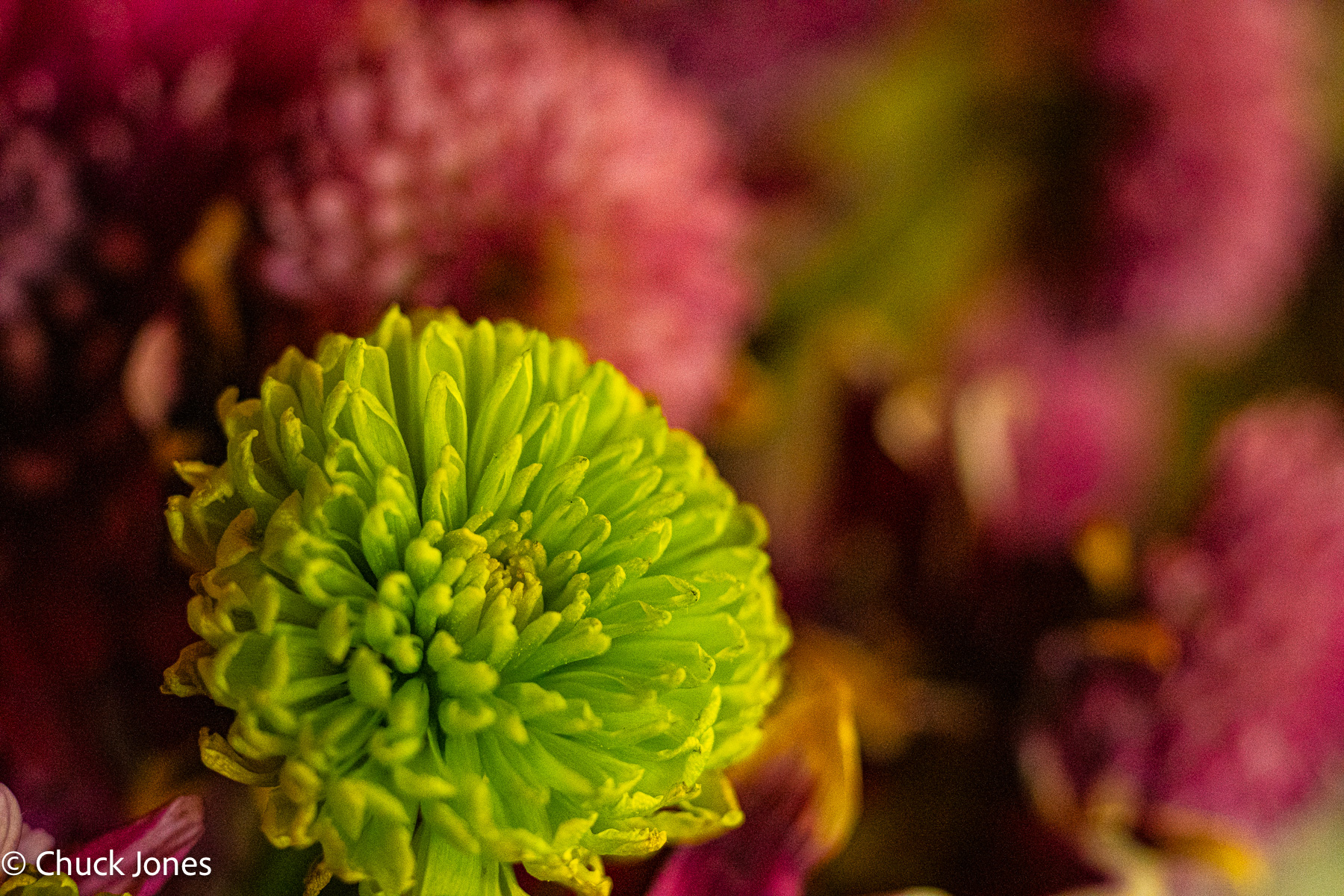
This is the image that answers the question. The chartreuse chrysanthemum sits in a narrow plane of critical focus while the pink and magenta blooms behind it dissolve into pure color. The spiral petal structure is resolved down to surface texture, individual cell structure visible on the outermost petals.
At ISO 6400 on the A7RV, there is no visible noise penalty in the areas that matter. The sensor and the lens are working together at a level that neither could achieve alone.
Purple and Gold
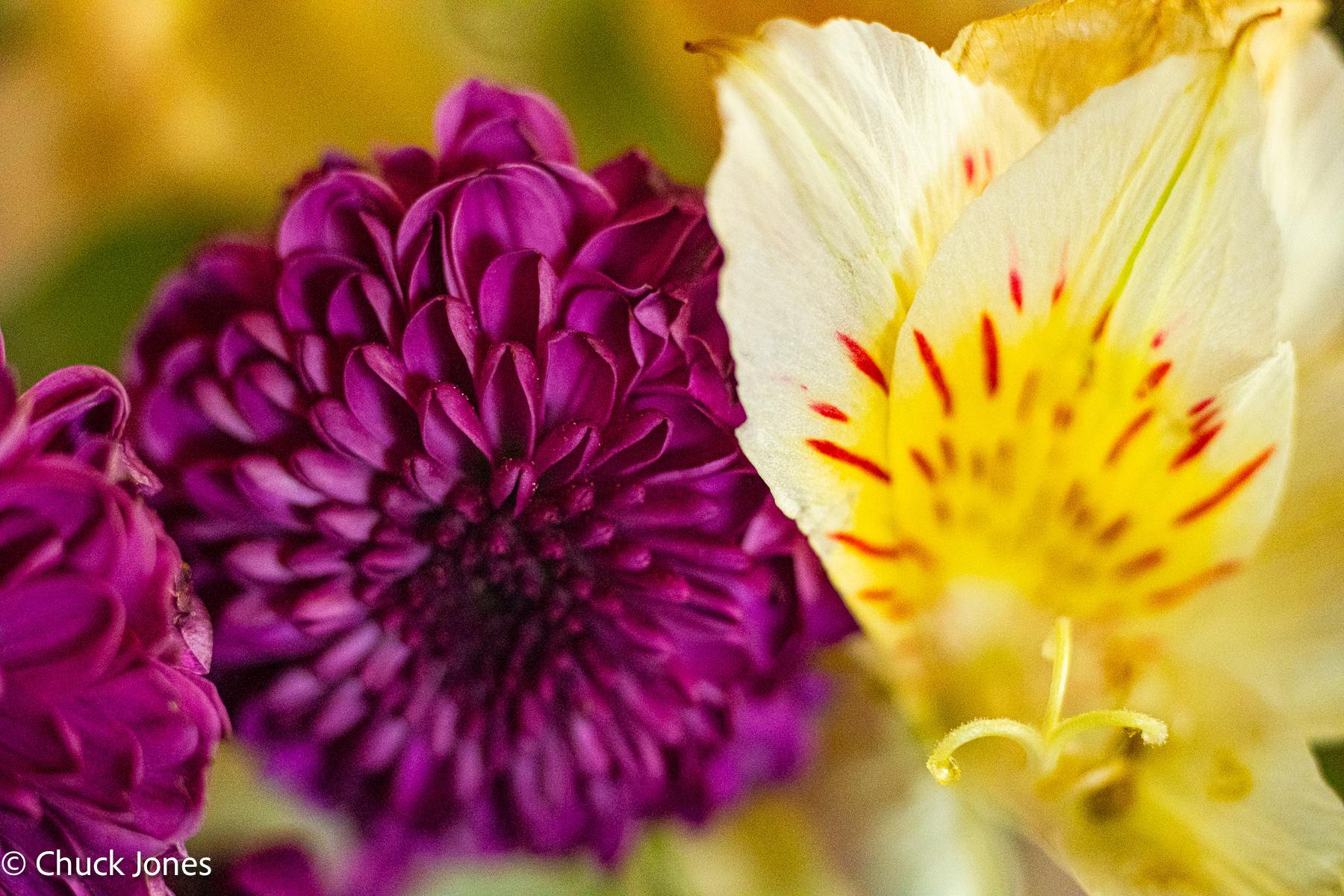
The purple chrysanthemum against the alstroemeria is a study in how the S-Planar handles color transitions. The deep violet petals curl inward with sculptural precision, each one resolved individually. The alstroemeria’s red-streaked throat provides a complementary color counterpoint, its stamens sharp enough to see the pollen texture on the anthers.
The T* coating handles the purple-to-yellow transition without any chromatic fringing. This is worth noting because cheaper macro lenses frequently struggle with high-contrast color boundaries at close focus. The S-Planar renders them cleanly.
Magenta Daisy
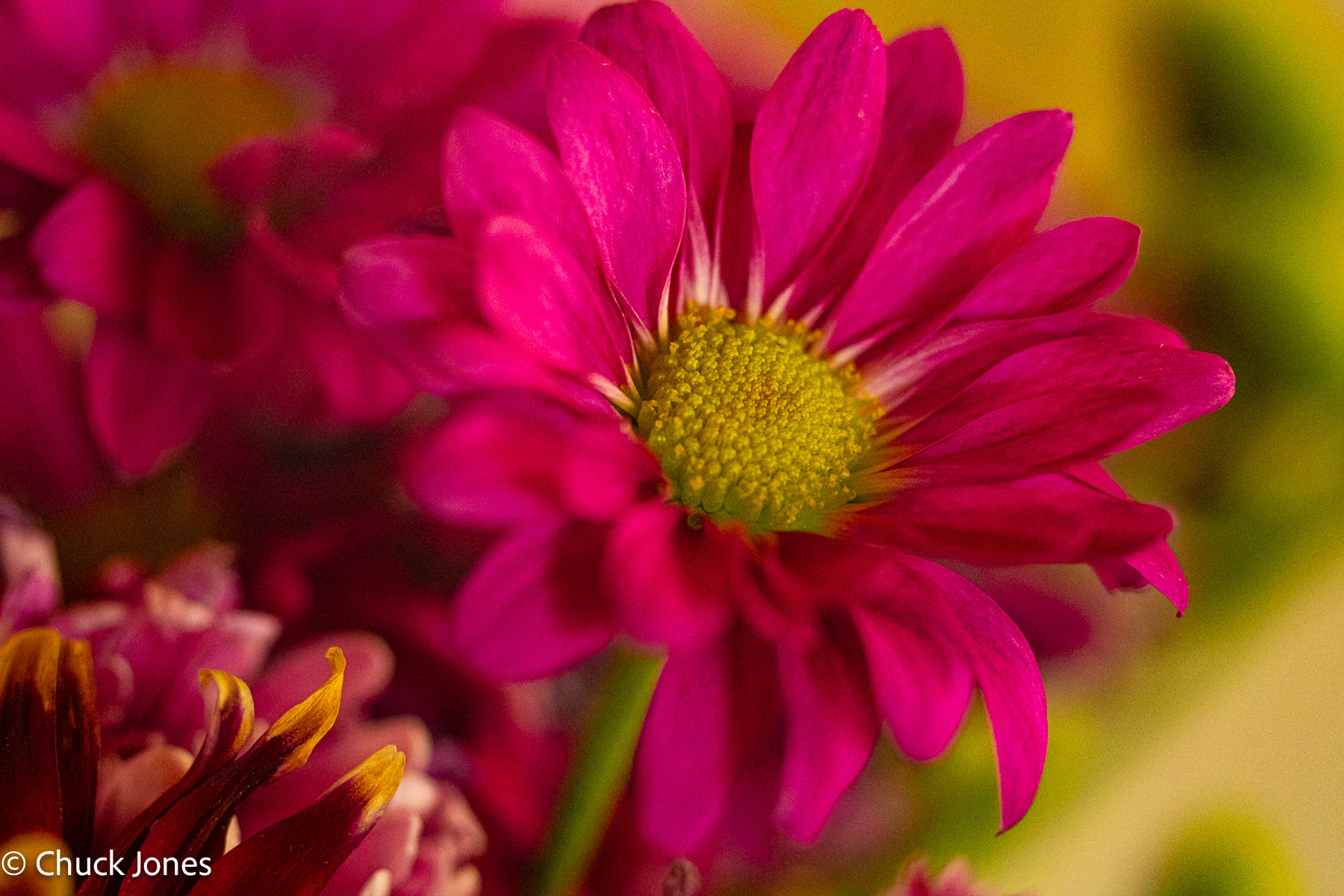
The magenta daisy is shot from slightly above, the disc florets tack-sharp and the ray petals falling away into progressively softer focus. The background dissolves into a warm wash of pink, yellow, and green. Notice the curled brown petals of a spent bloom in the lower left, a small reminder that beauty and decay live in the same bouquet.
At this magnification, the depth of field is perhaps three millimeters. The S-Planar’s rendering of the transition zone, the region between sharp and soft, is what separates great macro lenses from adequate ones. There is no harsh boundary. Focus simply melts away.
Dark Chrysanthemum
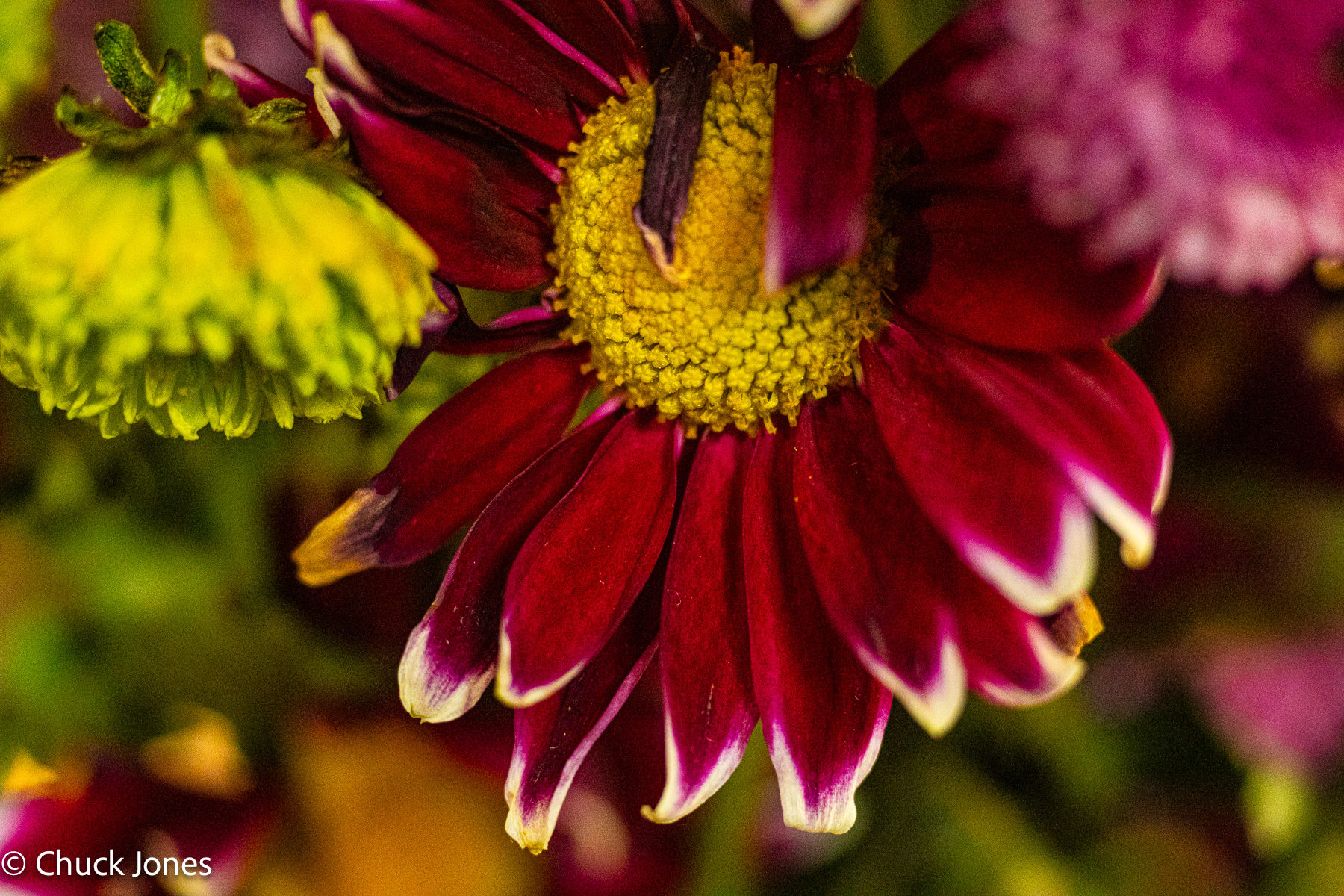
The dark red chrysanthemum is slightly past its peak, the petals curling back to reveal white tips and a golden-olive center. This is the image with the most character. A flower at peak bloom is a specimen. A flower just past peak is a portrait.
The S-Planar treats the subject with the same fidelity regardless of its condition. The white petal tips catch light with sharp precision. The dark red body holds detail in the shadows without blocking up. The green chrysanthemum in the background, out of focus, becomes a luminous accent rather than a distraction.
ISO 12800 here, and the image holds. The A7RV’s sensor gives you the headroom to work in available light at extreme magnification without resorting to flash, which would change the character of these images entirely.
Teal Orchid
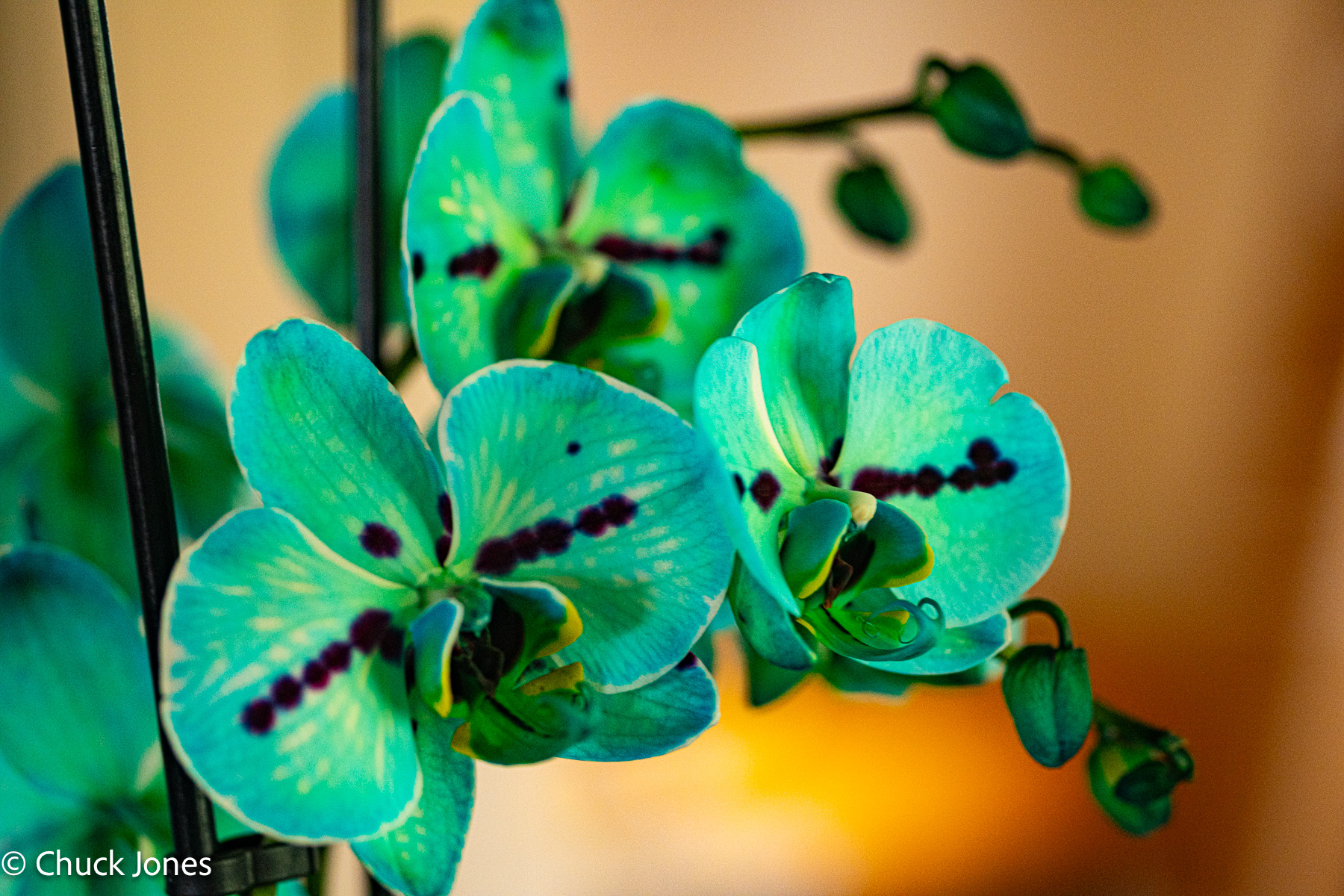
A dyed phalaenopsis, white petals infused with teal through the stem’s vascular system. The color is artificial. The rendering is not.
The S-Planar separates two blooms at slightly different focal distances, the forward flower sharp enough to trace the purple spotting along the labellum, the rear bloom softening just enough to read as depth rather than distraction. The warm amber background, an incandescent lamp through a doorway, provides the complementary color contrast that makes the teal sing.
This is a lens that does not editorialize. It does not flatter and it does not judge. It records what is in front of it with a neutrality that borders on ruthless. Whether the color grew there or was injected through a needle, the S-Planar renders it with equal precision.
Sixty-One Megapixels Later
Eleven years separate these images from the A7S originals. Five times the sensor resolution. The same lens.
The S-Planar does not care what sensor you put behind it. It resolved more than the 12-megapixel A7S could capture. It resolves more than the 61-megapixel A7RV can capture. The optical design Werner Mertz and his team at Zeiss created has more in it than any current sensor technology can extract.
On bellows, mounted on the best APS-C-cropped-to-full-frame body Sony makes, shooting kitchen-table flowers in afternoon light in northern New Mexico, the Carl Zeiss 100mm f/4 S-Planar does what it has always done.
It shows you what is there. All of it. More than you expected. More than you can use.
That is what great glass does. It has no ceiling.
Find a Carl Zeiss 100mm f/4 S-Planar at KEH Camera
Graded used copies with 180-day warranty.
TheCameraForum.com is an affiliate partner. We earn a small commission at no cost to you.